The First Woman to Run a Marathon Fueled on Nothing. Here's What Changed.
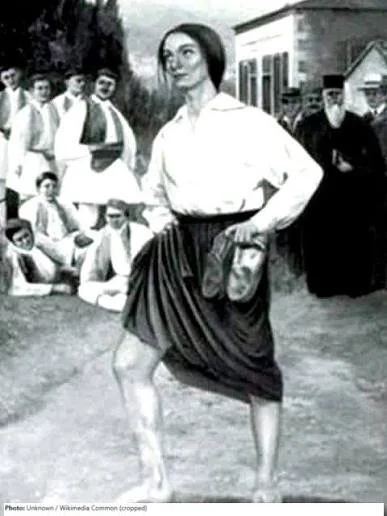
Stamata Revithi
A widow in a heavy skirt, running 40km on foot with no plan, no aid stations, and probably nothing more than bread in her stomach because the Olympics didn't think women's bodies could handle the distance. Stamata Revithi ran the 1896 Olympic marathon route unofficially after women were excluded from the first modern Olympic Games. The day after the men's race, she completed the Marathon-to-Athens route in approximately 5.5 hours, but was not allowed to enter the Olympic stadium. Her remarkable run received little recognition. The run remained an overlooked chapter in women's running history for decades!
Stamata Revithi ran the 1896 Olympic marathon route unofficially, one day after the men's race, after women were excluded from competing in the first modern Olympic Games. She completed the Marathon-to-Athens route in roughly 5.5 hours and secured signed statements from local officials along the route to verify her time. She was not allowed to enter the Olympic stadium at the finish, and her run went largely unrecognized for decades.
There's no record of any nutrition plan behind that run, because there wasn't one. Revithi was impoverished, breastfeeding a 17-month-old son, and running with essentially nothing in her system. She hoped a strong showing would bring her enough publicity to land a job and support her child. She ran the men’s only route to Athens fueled by little more than determination.
Violet Stewart Louisa Piercy: 37 Years, One Uterus Myth, and a Baby Ruth Bar
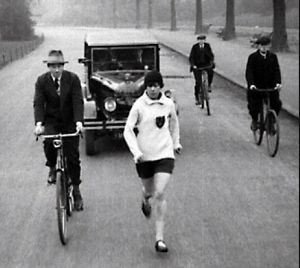
Violet Stewart Louisa Piercy, born in 1889 in Croydon, ran from Windsor to London on October 3, 1926, in 3 hours, 40 minutes, and 22 seconds on the Polytechnic Marathon course, one of the first regularly run marathons in Europe. She became the first British woman recognized for a marathon time, and her mark stood for 37 years, largely on grit rather than fuel. There’s no record she had any real strategy for eating or hydrating across that distance.
She kept going back for more. In 1928 she attempted the London marathon again and stopped at 20 miles due to heat exhaustion. In 1933, she completed 22 miles in 3 hours 45 minutes through sleet and rain, in a run approved by the Women's Amateur Athletic Association.
Long-distance running was actively discouraged for women during this era, and officially banned in competition. The prevailing belief, reinforced by reports of exhausted runners collapsing in the 800m at the 1928 Olympics, was that women's bodies weren't built for endurance, and some went so far as to claim distance running could damage a woman's reproductive organs. It's wild by today's standards, but it shaped policy. The Women's Amateur Athletic Association limited women's races to 1,000 meters or less.
Piercy ran anyway. In 1936, at 46 years old, she was finally permitted to run the Polytechnic Marathon itself, on the condition she start ahead of the male field as the only woman entered. She finished in 4 hours 25 minutes. Not competing against the men, she said, but proving a woman could stick out the distance. After World War II she moved frequently and faced hardship, she died in 1972 after a brain hemorrhage. She remains one of the pioneers of women's distance running.
New Records
Marie-Louise Ledru, a French athlete, completed the marathon distance at the Tour de Paris Marathon on September 19, 1918, a run some statisticians now credit as the actual first female marathon finish. Arlene Pieper became the first woman to officially finish a sanctioned marathon, the Pikes Peak Marathon, in 1959.
At the 1963 Western Hemisphere Marathon, Merry Lepper and her training partner Lyn Carman hid behind a hedge near the start line and slipped into the field once the gun went off. Lepper finished in 3:37:07, breaking Piercy's 37-year-old mark. She did it running on a Baby Ruth candy bar, having been in too much of a rush that morning to eat breakfast!
Dale Greig broke 3:30 for the first time in 1964, running 3:27:45. Just months later, Mildred Sampson posted a time of 3:19:33, though record-keeping from this period is spotty enough that historians still debate its accuracy. In May 1967, Maureen Wilton, just 13 years old, ran 3:15:23 in Toronto, becoming one of the youngest world-record holders in any sport. Four months later, Anni Pede-Erdkamp took the mark down to 3:07:27!
The Diner Breakfast That Fueled a Revolution
In 1966, Roberta Gibb hid in the bushes near the start line of the Boston Marathon and became the first woman to run and finish the course, in 3 hours, 21 minutes, and 40 seconds, entirely unofficially. She'd return to run it again, still unofficially, in 1967 and 1968.
A year after Gibb's run, Kathrine Switzer became the first woman to run Boston with an official race number. Nothing in the rulebook explicitly barred women, so she registered as "K.V. Switzer" and toed the line on April 19, 1967. That freezing morning, her training group ate a huge cold-weather breakfast before heading to the start. This included bacon, eggs, pancakes, juice, coffee, milk, extra toast. It wasn't a fueling strategy. It was just what was in front of them on a cold morning before 26.2 miles.
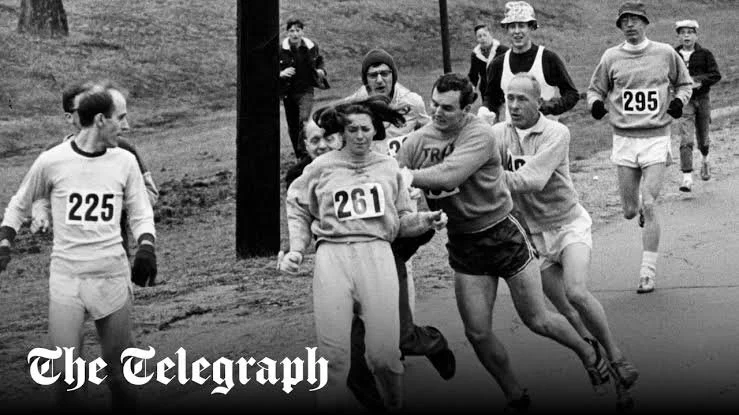
A few miles in, race director Jock Semple grabbed Switzer and tried to physically pull her off the course. Her boyfriend body-checked him out of the way. She finished the race anyway, and the photo of the confrontation became one of the defining images of the women's running movement. Bib 261 is still remembered today.
At age 70, Switzer ran Boston again. By then her approach to fueling had changed almost as much as the sport around her. She’s said she doesn't count calories or follow trends, joking that her diet is a “SEE-FOOD-DIET” as if she sees food, she eats it. She has mentioned leaning more toward protein and fresh produce at 70 than she did as a younger runner, when she had no nutrition plan at all.
Marathon Fueling Today

Compare all of this to a modern-day distance training plan, with nutrition integrated from the very beginning. Today’s marathoners don’t simply train their legs and lungs. They train their ability to fuel, hydrate, and recover! Heck yes! Runners should increase carbohydrate intake in the days leading up to a marathon, practice taking gels or other carbohydrate sources during long runs, and develop a hydration strategy that can be adjusted based on individual sweat rates and environmental conditions. During a marathon, fueling is often planned at regular intervals. I recommend refueling frequently (every 25–40 minutes) rather than waiting until the body is completely depleted.
When we look at the history of women’s distance running, the women who helped establish women’s marathoning were competing when many of the nutritional strategies that are now considered fundamental to endurance performance did not exist. There was no widespread concept of training the gut to tolerate carbs during a marathon, no individualized sweat testing to determine fluid and electrolyte needs and losses. There were no sports nutritionists personalizing nutrition and hydration strategies for these runners. These athletes were pushing the boundaries of what women were believed to be physically capable of while operating with an extraordinarily limited understanding of how to fuel that effort.
Distance running has helped drive the evolution of sports nutrition ever since. The sport has shifted from asking how far and how fast someone can run to asking how well she can fuel the work it takes to get there. Modern female distance runners can individualize carbohydrate intake, hydration, electrolytes, and recovery based on training demands and their own physiology, and sports nutritionists can help runners train the gut, dial in hydration, and figure out exactly what fuel works for them.
Takeaway
The women who built this sport's history didn't have smartwatches, pacers, gels, or a coach checking their fueling windows. They had determination and almost no information, and they still went the distance, which, honestly, was very dangerous. Today runners have the opposite problem. Way too much conflicting advice online. That also means we finally have the tools to actually personalize a plan, something the first women in this sport never had. Now we can actually personalize and PLAN!
If Stamata Revithi could run 26 miles on empty, what's your excuse for skipping your fueling plan on race day?
What's your go-to marathon fuel? Drop it in the comments below! I'd LOVE to learn more about what's carried you through your own 26.2 journey!
