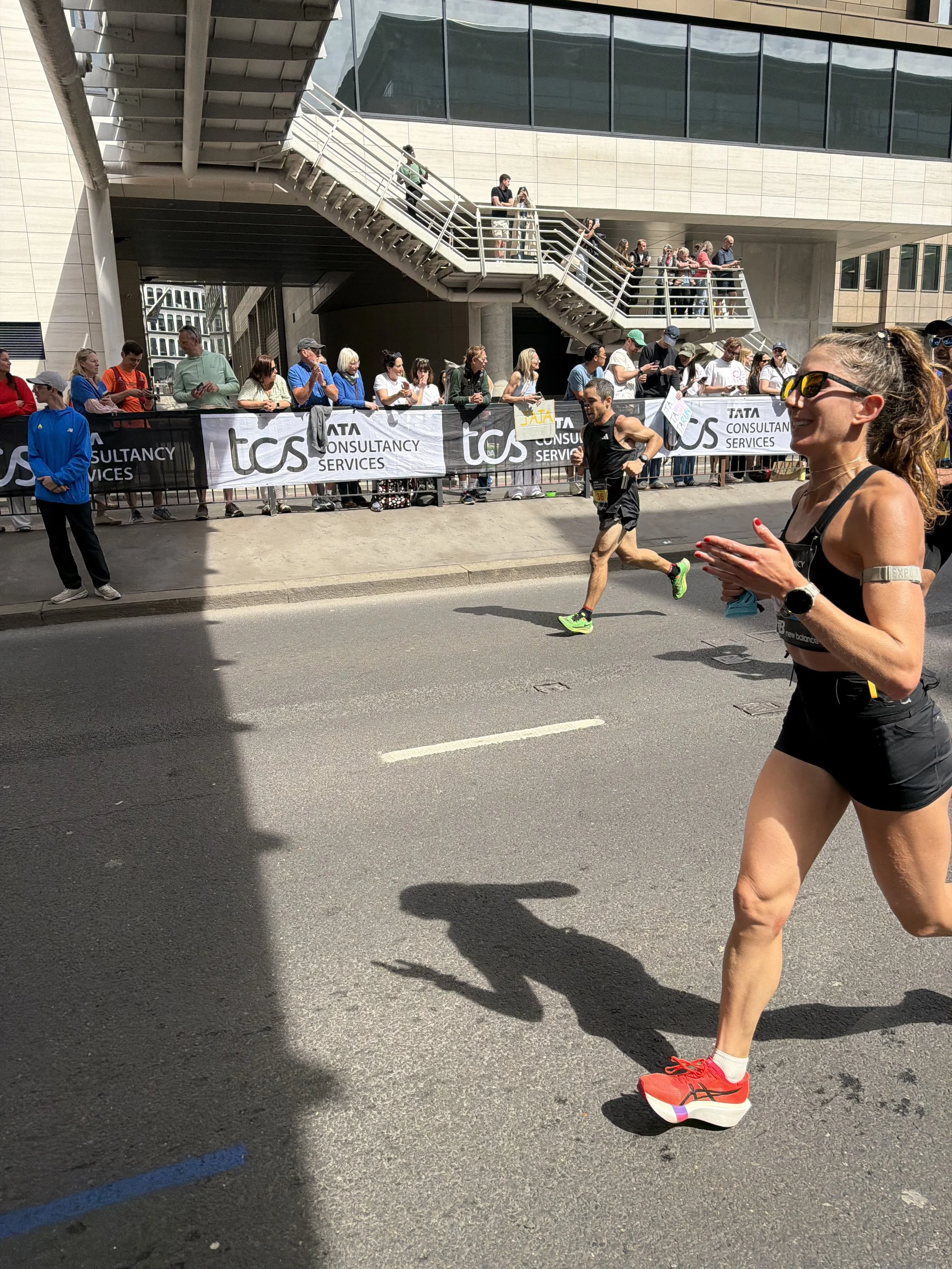
Why Your VDOT Doesn't Predict Your Marathon Time (And Why That's Actually Good News)
Why Your VDOT Doesn't Predict Your Marathon Time (And Why That's Actually Good News)

You run a 24-minute 5K.
According to the VDOT tables, you're theoretically capable of running a sub-4-hour marathon.
Then race day comes.
Mile 18 hits.
Everything falls apart.
What happened?!
Was the VDOT chart wrong?!
Not exactly.
Let's talk about one of the biggest misconceptions runners have about Jack Daniels' VDOT system, and how understanding it can make you a much smarter athlete!
First Things First: Stop Chasing Every Piece of Running Advice
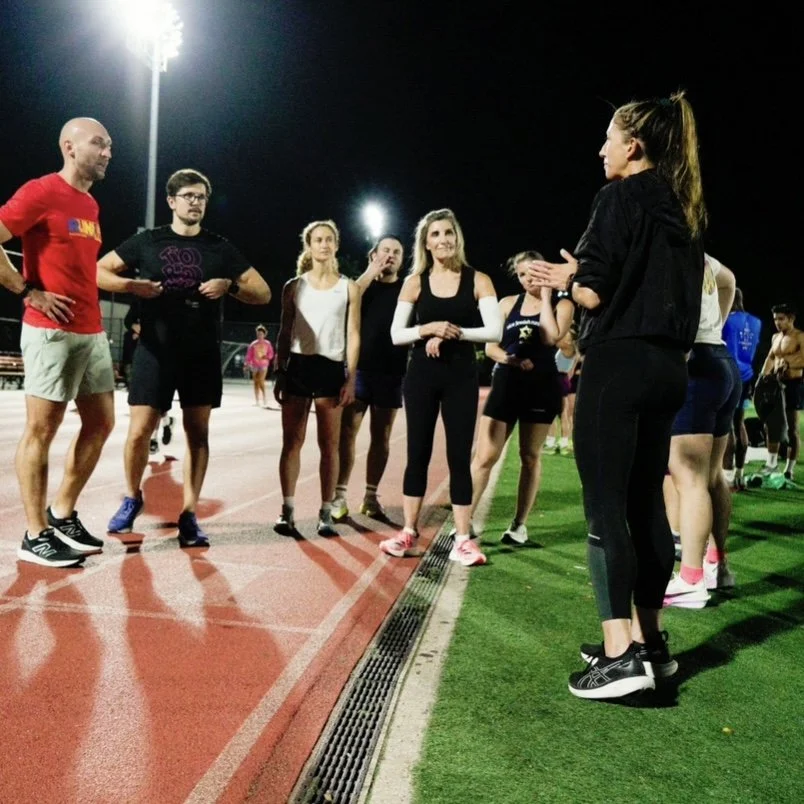
Every athlete responds differently to training. Context always matters more than a generic training tip.
One-size-fits-all advice is exactly what it sounds like.
It's important to recognize that social media provides general information. Not guidance tailored to your individual needs. With an overwhelming amount of information available online, it's easy to get distracted by every new trend or "shiny object." Instead, trust your training plan, consult with your coach, and lean on your training partners when questions arise.
Remember, your training history, nutrition, recovery, work demands, life stress, sleep, and countless other factors all influence how you adapt to training. They also determine when your training may need to be adjusted to optimize performance while reducing the risk of injury or burnout.
That's why I coach using VDOT, but always through the lens of the individual athlete. Data is valuable, but context is everything. It's imperative to coach the person first and the athlete second.
What VDOT Actually Measures
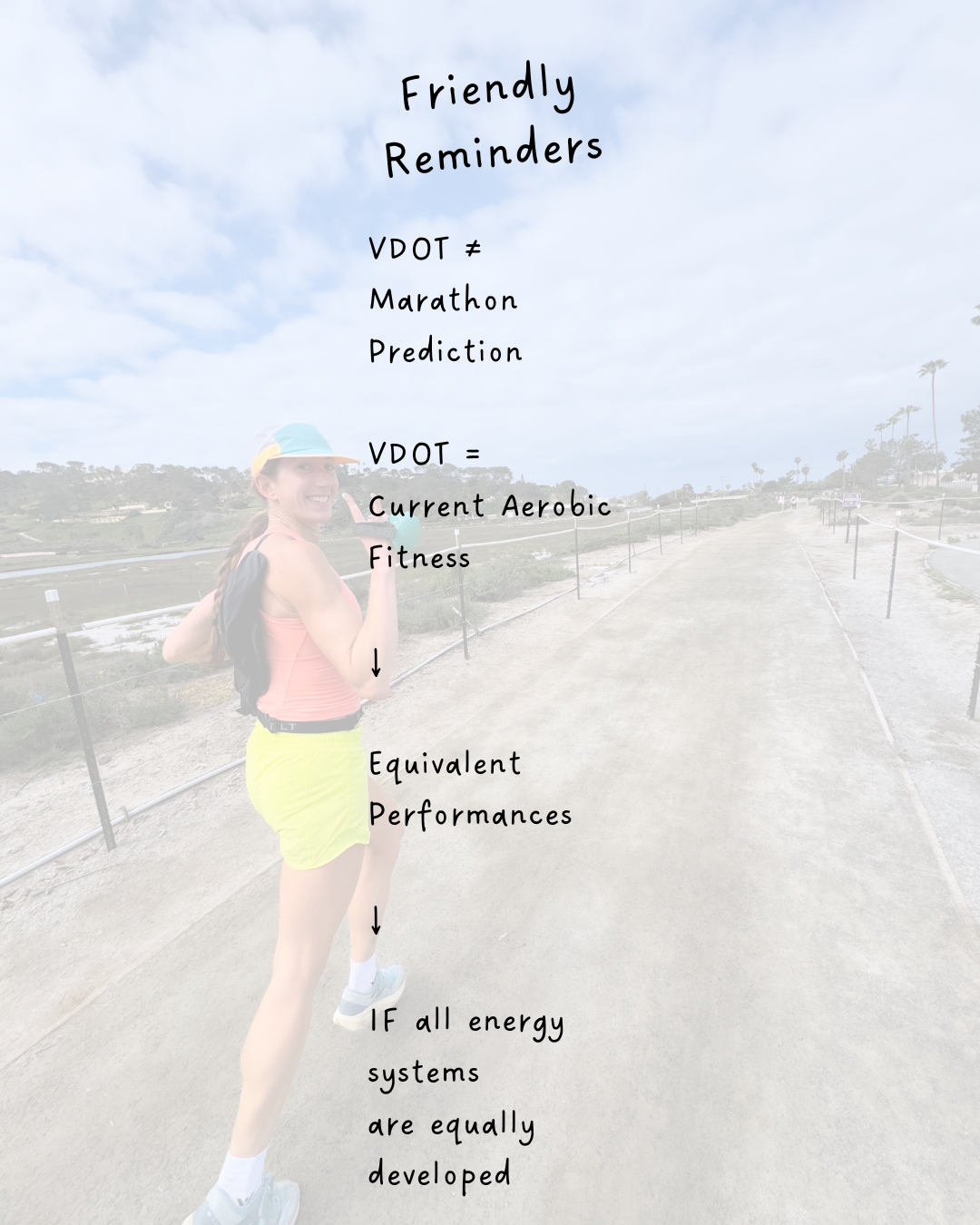
A common misconception about the Jack Daniels VDOT tables is that the chart predicts what you will run at every distance. It doesn't! Hear me out.
The chart is really saying that if your aerobic fitness is at a certain level, these performances are theoretically equivalent if ALL systems are equally developed. By systems, I mean your energy systems (there are three), and it's nearly impossible to train all of them equally at the same time. That's why we focus on 5K-specific training during certain times of the year and marathon-specific training during others.
Almost nobody has equally developed systems, and that's okay!
Remember: a marathon is not an extended 5K. It is COMPLETELY different, and so is the training. So train for the race you’re actually running.
VDOT is NOT predicting what you'll run. It's showing what performances could be equivalent if every energy system were equally developed.
The Phosphagen, Glycolytic, and Aerobic systems produce ATP, the energy your muscles use. They work together and shift continuously based on run intensity and duration.
Activities up to 10 seconds primarily rely on the Phosphagen System. Efforts from 10 seconds to about 2 minutes primarily use the Glycolytic System. Activities longer than 2 minutes rely predominantly on the Aerobic System, fueled by carbohydrates, fats, and, to a lesser extent, proteins.
Train all three energy systems because they're interconnected. While every run uses all three to some degree, different workouts emphasize one system more than the others. A well-rounded training plan develops each system at the right time to help you become a stronger, faster, and more efficient runner.
Why the Marathon Is Completely Different
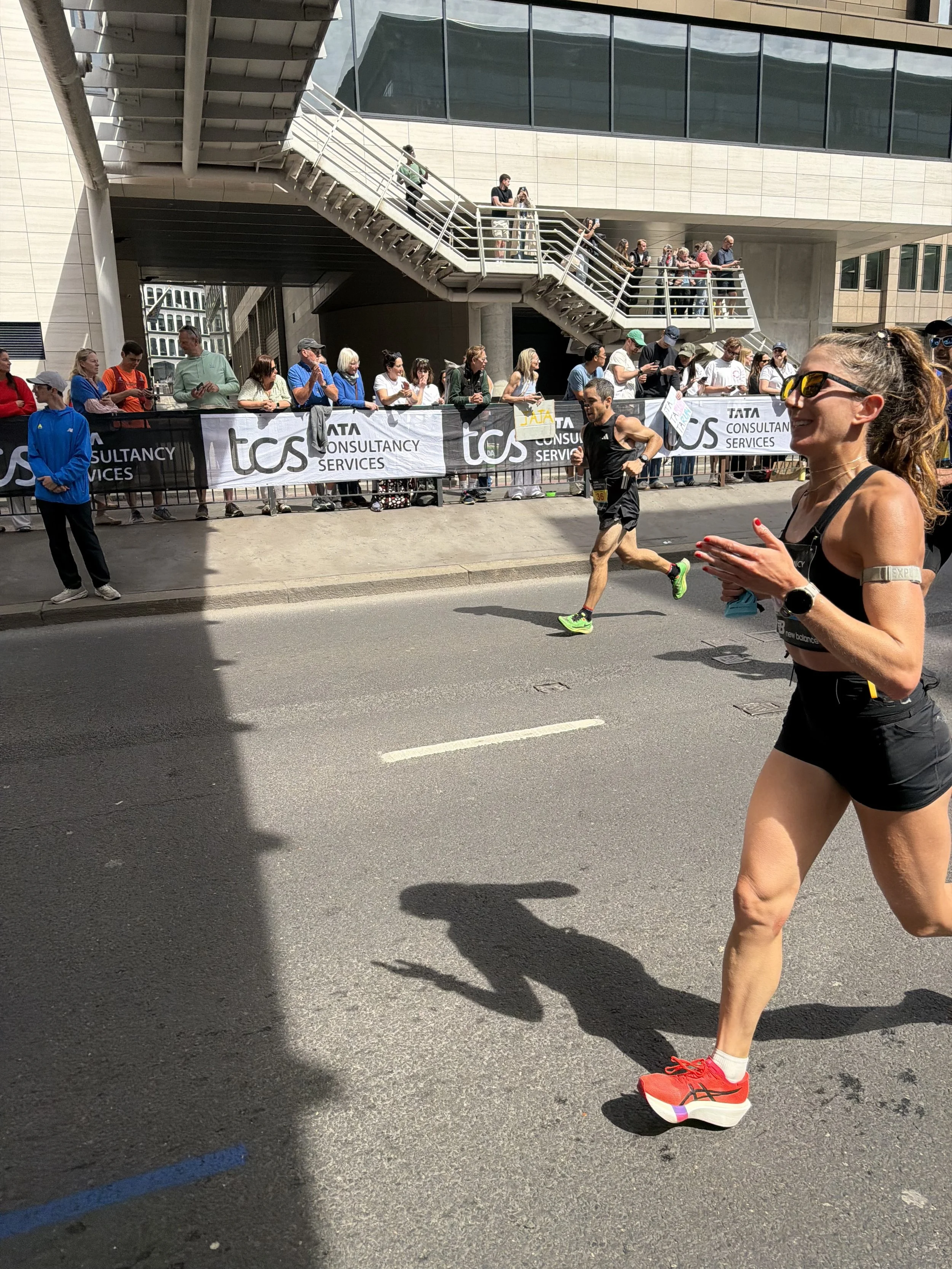
Marathon success depends on much more than speed. Fueling, pacing, hydration, durability, and recovery all matter.
Durability. Your body needs to get acclimated over time (this can be year over year or over months) to tolerate the demands of running for hours at a time. It’s the ability to maintain the same power output or effort in that last 10K of the marathon distance. This is important for long-term health and injury-prevention as well. For example, a durable marathon runner could look like someone who has trained their body and stomach to use fat and carbohydrates as fuel, so that later in the race they avoid hitting the wall, or “bonking,” by training both metabolic systems throughout training. Durability is built through strength, fatigue resistance, and nutrition throughout training. This is why periodizing your training is crucial to your success as an athlete and durability as one. Building your base while working on speed endurance before heavying up on the aerobic work and marathon-specific work 20-16 weeks out from a marathon, since that specificity (long runs, long run workouts with MP time on feet) is important closer to the marathon, but not for weeks on end throughout the year before it. Year after year, with consistency and proper periodization, challenging your body and knowing when to recover and back off builds durability.
Glycogen. Practice fueling during most of your runs (Not just long runs) with fuel sources of choice. My go-to is Neversecond C30 Citrus or Passion Fruit for a marathon, with its science-backed, tested 2:1 glucose-to-fructose ratio, which means GI issues won’t be a concern during any training run, especially on race day! Additionally, teaching your body to use fat as fuel while sparing glycogen during longer runs will allow you to use two different fuel sources during the marathon. This can also be manipulated by diet and the timing of consuming different macronutrients around your long runs.
Fueling. A non-negotiable for any run of any distance. Eating frequently (5-6x a day) around your runs with carbohydrate, proteins, and fats, avoiding fasted workouts or runs, and eating within a 15-60’ window after your runs will allow you to recover better, optimize performance and training adaptations, train your stomach (& body and brain) to use fuel efficiently to optimize performance in and out of training and over time, keep you from getting injured and burning out!
Muscular endurance. Through proper strength training, cross-training, long runs, and running on varied terrain throughout training, you will allow your muscles to adapt to the stress of the long run, which is ultimately the marathon, with the ability to hold form and pace (or effort) that lasts 10K, similar to durability mentioned above.
Time on feet. Instead of focusing on distance, focusing on time on feet is more conducive to your success as a marathon runner, since the marathon is essentially time on feet, like any long run! For example, take two runners who each run between 7 and 10 hours a week. One runner may cover 35-40 miles a week, whereas another may cover twice that amount, but the constant here is the time spent. The range of efforts from Zone 1 to Zone 5 will dictate how much volume you run within those hours, and this varies for each individual. A sub-4-hour marathon runner’s Zone 2 paces might look different than a 3-hour 30-minute marathoner, and the workout paces will definitely look different, but worrying about how much time you spent to get your body used to the stress of being on your feet for hours on end throughout the week is critical for the marathon, and a confidence builder, too!
Pacing. Learning to pace and how to dial it back in the first half of a marathon is a true skill that should be practiced at different effort levels during different runs and workouts in training. And it’s hard! When in doubt, slow it down, and practice running without looking at the watch at an effort that feels relative to the prescribed pace in your training. The more you practice, the better you’ll get with this. Understanding how your body feels at different paces (or efforts) is crucial as well. The more you learn to run by feel, the more you’ll learn how to pace yourself, best knowing when to dial it back and push, having that experience from your training! And it will change year after year, but know what to expect!
The marathon demands:
Long-run adaptations
Fueling strategy
Hydration practice
Mental resilience
Recovery
Aerobic durability
Race execution
This is why it’s a different event compared to a half marathon, 10K, or 5K! Expect to practice all of these during your training.
My Own Experience
I improved my marathon by 19 minutes, but not because I was marathon training year-round. I started by:

Chasing a faster 5K. After running the TCS NYC Marathon in 2019 and plateauing at a 3-hour-22-minute PR over four consecutive marathons, I wanted to chase a faster one. Since I took up running as an adult, chasing half and full marathons first without learning how to run fast or race faster over shorter distances, I was set on improving. So I did it. I adjusted my training with the guidance of my coach at the time to get faster at the 5K distance while working on my running technique, once mentored by Dr. Michael Yessis, and learning how to run fast. A skill. I dropped my 5K PR from 19:37 minutes to 18:18 in a little under 1.5 years, and I still have work to do! This didn’t directly impact my marathon time, but, when it came time for the marathon training block to begin, I had a greater ability to holder a higher fraction of my 5K mile race pace (or a faster speed) than I had when I ran a 3 hour and 22 minute marathon for the fourth consecutive time in a row in the marathon distance at the 2019 TCS New York City Marathon. After COVID hit, and I truly periodized my training, incorporated speed work, strength, and lots of cross-training in a MUCH more personalized program, I ran a 3 hour and 2 minute marathon at my first attempt to break three hours in the marathon distance at the 2021 Rock ’n’ Roll San Diego Marathon before breaking 3 hours at the Bank of America 2022 Chicago Marathon in 2022.

Becoming stronger.I incorporated strength training, strides, and hill sprints regularly into my training around my runs, leaning heavily into strength and its forms during speed blocks usually during the summertime before my marathon build.
Improving economy & technique. I focused on fine-tuning my running technique, practicing my knee drive, pawback, and ankle extension at push-off to enhance my running economy and form, improving my ability to run faster and more effortlessly with better control.
Then, building for my marathon. I focused on marathon-specific runs, runs at goal-marathon pace, and felt stronger, with goal-marathon pace feeling a bit easier than I had expected it to feel, while also having more control over my body throughout my long runs in training and not feeling completely wiped at the end of them. I attribute a lot of that to nutrition as well, not just training and recovery between sessions!
Why Some Runners "Outperform" Their VDOT
Example 1
Runner A
Can run a 25-minute 5K
Fades after 15 miles
This runner likely needs:
Fueling
Endurance
Pacing
Durability
NOT more speed.
Example 2
Runner B
Can barely run a fast mile. Yet crushes marathons.
This running has excellent:
Aerobic development
Efficiency
Endurance
I can relate to Runner B a lot, as I felt confident in the marathon before running a faster mile or 5K. Leaning into your strengths AND weaknesses at the right time throughout the year to work on speed (or endurance, fueling, pacing, and durability) is different for everyone, which is why cookie-cutter programs are not helpful in getting what they need when these variables are at play. Working with a coach who gets you will help you to level up.
The Marathon Exposes Weaknesses
The marathon punishes weaknesses.
Short races let you get away with:
Poor fueling. You don’t NEED to fuel for a half-marathon (and under), although it may help. Your body will physically run out of nutrients after about 90-120 minutes of continuous running or marathon running/walking.
Poor pacing. Consistent pacing, especially when practiced this way during training, always wins. Pacing differently in a race than you’ve practiced during training will cost you potential, burning through glycogen way too quickly, outrunning your fitness (or trying), and leading you to slow down way earlier than you’d like.
Lack of durability. There is less emphasis on holding form for shorter distances than in a marathon because they are shorter and, usually, we’re not out there for hours on end on our feet. For example, in a 5K, your body doesn’t experience glycogen depletion since it’s both anaerobic and aerobic, and you can run closer to your max effort with your form falling off!
The marathon doesn't.
Why I Recommend Periodizing Your Year
Speed & Strength (Anywhere during your preparation phase, which can be as little as 12 weeks to as long as you want, but giving yourself at least 20 weeks to heavy-up on marathon-specific training more or less). Focus on specific training for the following distances in this order:
↓
5K/10K
↓
Half Marathon
↓
Marathon
Use a reverse linear periodization model (which this follows), focusing on intensity and speed before heavying up on volume and slower, longer tempos (or less intense quality sessions) in your marathon build. This helps to prevent burnout, incorprate variety so you don’t plateau fitness-wise, and teaches you how to touch different energy systems and gears throughout different parts of the year. All which are conducive to when that marathon build starts! When you are in your best 5K shape, and the marathon pace chart equivalent says what you can run in the marathon, you still need to build the endurance and specificity for the marathon distance. This can take years, a different strategy than you‘ve done before, it’s very theoretical, and there is something that works for everyone.
This is why the marathon is my favorite distance. It takes into consideration someone’s training history, physiology, for women, the menstrual cycle, strengths and weaknesses, nutrition and hydration, time on feet, durability, mental capacity, and so much more. There are so many ways to get creative with marathon training by incorporating run commuting or brick workouts into this specific block. This could make training doable for the Dad with a full-time job and three kids, or the busy Mom carpooling her kids all over before and after school and on weekends. But overall, consistency is the game’s name, and with that said, missing one run, or a week in a marathon build won’t make or break your marathon race day, regardless of what that build looks like, or how fast you plan to run the marathon!
My 5K to Marathon Training Plans Can be Found Here!
The Marathon Is Usually the LAST Distance to Improve

Your mile and 5K often reveal what's possible. The marathon is usually the last distance to catch up.
During marathon training, aerobic development is important, but so are fueling and hydration, learning what works for your body, pacing, understanding how you tolerate different weather and environmental conditions, mental resilience, long-run and time-on-feet adaptations! These are things you simply don't get from 5K-specific training alone. So yes, someone may have the mile speed required for a sub-4-hour marathon and still struggle to run one. The opposite can also be true! Another runner may be able to hold marathon pace exceptionally well, outperform their VDOT prediction, and not be particularly strong at the mile. I often see runners whose mile times are already faster than what the VDOT chart suggests for their marathon goal. It simply means they need to keep building their aerobic engine, improve their ability to handle the distance, become more durable, and spend more time on their feet during a marathon buildup when the time comes.

VDOT Race Predictor
What Should You Focus On Instead?
If your speed already supports your marathon goal, Focus on:
✅ Weekly consistency
✅ Aerobic development
✅ Marathon-specific workouts
✅ Long runs
✅ Fueling
✅ Hydration
✅ Recovery
✅ Staying healthy
Not chasing another random speed workout from Instagram!
Final Thoughts
It took me three years to break three hours in the marathon. It didn't happen overnight!
It wasn't linear.
It required patience, consistency, and trusting the process. The same is true for nearly every marathon runner I coach. If your shorter-distance performances suggest you have the speed to reach your marathon goal, don't become discouraged if the marathon hasn't caught up yet!
Keep building the aerobic engine. Keep showing up. Keep practicing your fueling. Keep developing durability. And most importantly, keep your training FUN! Your marathon is often the last race to reflect all of those fitness gains.
Want More Free Running Tips?
Join our FREE RunWithAlli Discord community where I share weekly:
Training tips
Nutrition guidance
Recovery strategies
Strength workouts
Live Q&As
Running discussions with athletes from around the world
Looking for Personalized Coaching?
If you're ready to stop guessing and start training with a plan built specifically for YOU, we’d love to help!